
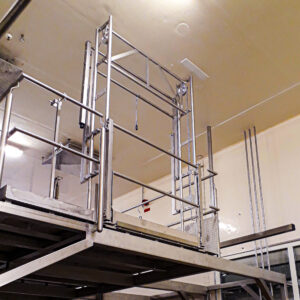


Yes, a safety gate can be manufactured in stainless steel. In fact, a stainless steel safety gate is a highly suitable solution for certain working environments. Examples include the food processing industry, pharmaceutical industry, chemical industry, and other environments where hygiene, cleanability, and corrosion resistance are important.
Haagh Protection can manufacture VARIOGATE® safety gates and other customised safety solutions in both stainless steel 304 and stainless steel 316. This allows the material to be selected according to the conditions in which the safety gate will be used.
A safety gate, also known as a pallet safety gate or loading gate, is used to safely protect openings at height. For example, at a pallet loading point on a mezzanine floor, intermediate floor, or elevated working platform.
The safety gate allows goods to be safely transported through an opening while protecting the opening itself against fall hazards. The correct choice of material depends on the environment in which the equipment is installed.
In a standard warehouse environment, for example, a coated or galvanised steel version is often sufficient. In environments with high levels of moisture, aggressive substances, or strict hygiene requirements, stainless steel may be the better choice.
A stainless steel safety gate offers several advantages compared to standard steel. The main benefits are:
Especially when a safety gate is regularly exposed to moisture, cleaning agents, or certain chemical substances, stainless steel can provide significant added value.
A stainless steel safety gate is therefore not only an aesthetic choice. The choice of material directly affects the service life, maintenance requirements, and suitability of the equipment for the specific working environment.
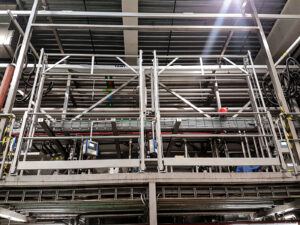
Variogate 30-HI Stainless Steel 3
The most common stainless steel grades for industrial applications are stainless steel 304 and stainless steel 316. Although both materials offer good corrosion resistance, there are important differences.
Stainless steel 304 is a commonly used stainless steel grade for industrial and hygienic applications. The material offers a good combination of corrosion resistance, durability, and cost efficiency.
Stainless steel 304 is often used in environments such as:
For many applications, stainless steel 304 is an excellent choice.
Stainless steel 316 generally offers higher corrosion resistance than stainless steel 304. This is partly due to the addition of molybdenum to the alloy.
This makes stainless steel 316 particularly suitable for environments where there may be exposure to:
For a safety gate installed in an environment with an increased risk of corrosion, stainless steel 316 may therefore be the preferred choice.
The right choice depends on the conditions in which the safety gate will be used.
| Property | Stainless steel 304 | Stainless steel 316 |
|---|---|---|
| Corrosion resistance | Good | Very good |
| General industrial application | Suitable | Suitable |
| Food industry | Often suitable | Suitable |
| Exposure to chlorides | More limited | Better suited |
| Chemical environment | Depends on the situation | Often better suited |
| Cost | Often more economical | Often higher |
Important: Stainless steel 316 is not automatically the best choice for every application. The correct stainless steel grade should be selected based on the actual environment, the substances present, the cleaning method, and the desired service life.
Therefore, it is advisable to assess the complete application in advance when selecting a customised safety gate.
The food processing industry often has high requirements regarding hygiene and cleanability. Equipment and safety solutions may be cleaned regularly and exposed to moisture or cleaning agents.
A stainless steel safety gate can offer advantages in such conditions compared to a standard steel version. The smooth and low-maintenance surface makes stainless steel suitable for environments where hygiene plays an important role.
Depending on the specific cleaning agents and operating conditions, stainless steel 304 or stainless steel 316 can be selected.
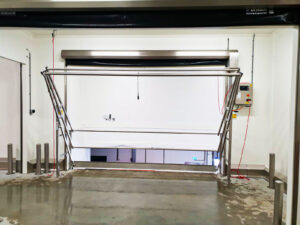
Variogate 22 – Stainless Steel 316
In the chemical industry, safety solutions may be exposed to substances that can cause corrosion. In such cases, it is important to consider not only the construction of the safety gate but also the material compatibility.
Stainless steel 316 can be a suitable choice in certain chemical environments due to its higher corrosion resistance compared to stainless steel 304. However, the exact suitability depends on the specific chemicals, concentrations, temperatures, and duration of exposure.
For these applications, customised advice is therefore important.
In principle, the VARIOGATE® systems from Haagh Protection can also be manufactured in a stainless steel version. Both stainless steel 304 and stainless steel 316 are possible options.
This means that not only the material can be customised, but also the design and configuration of the safety gate. Examples include:
A standard safety gate is therefore not always necessary. When a standard solution does not fit the situation, a customised system can be developed.
To determine the right version of the safety gate, it is important to first identify which substances the system will be exposed to, such as water, cleaning agents, acids, chemicals, or salts. This influences the choice between stainless steel 304 and stainless steel 316.
The cleaning frequency also plays an important role: a safety gate that is intensively cleaned on a daily basis has different material requirements than a safety gate installed in a dry production hall.
The required dimensions are also important. The size of the pallet, the available opening, and the surrounding space determine which version is suitable.
Furthermore, the way the safety gate is used must be considered, for example when transporting pallets with a forklift or reach truck. The operating situation partly determines the most suitable design.
Finally, specific building conditions, such as a fire door, limited installation height, an overhead crane track, or restricted depth, may influence the required construction.
When a standard safety gate does not suit the application, a customised solution provides the answer. Haagh Protection manufactures VARIOGATE® safety gates in various dimensions and material versions.
The following options are available, among others:
By carefully assessing the working environment and technical situation in advance, a safety gate can be designed that fits both the available space and the conditions in which the system will be used.
Would you like to know more about the possibilities for a customised safety gate? Visit the Customised systems page of Haagh Protection.
Yes. Haagh Protection can manufacture customised VARIOGATE® safety gates in both stainless steel 304 and stainless steel 316.
That depends on the application. Stainless steel 304 is suitable for many general industrial and hygienic applications. Stainless steel 316 offers higher corrosion resistance and may be better suited for environments with aggressive substances, chlorides, or demanding cleaning conditions.
Yes. Stainless steel is widely used in environments where hygiene, cleanability, and corrosion resistance are important. The correct stainless steel grade depends on the specific conditions.
Stainless steel 316 can be a suitable choice for certain chemical environments. The actual suitability must be assessed based on the substances present, concentrations, temperature, and exposure conditions.
Yes. In addition to the choice of material, the dimensions and construction can also be adapted to the specific situation. Examples include limited installation space, non-standard openings, and special building conditions.
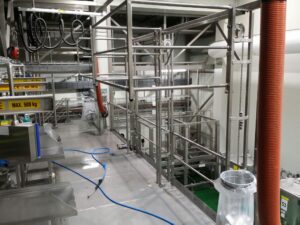
Variogate 30 Stainless Steel
A stainless steel safety gate is not only possible, but also a highly suitable solution for certain working environments. Especially in the food processing industry, chemical industry, pharmaceutical sector, and other demanding industrial environments, stainless steel can provide significant added value.
The choice between stainless steel 304 and stainless steel 316 depends on the conditions in which the safety gate is used. Stainless steel 304 is widely applicable, while stainless steel 316 can offer additional protection in environments with a higher risk of corrosion.
Haagh Protection can manufacture VARIOGATE® safety gates in both stainless steel versions. Even when a standard solution does not fit, a customised system can be developed that meets the dimensions, usage requirements, and conditions of the working environment.
Would you like to know which stainless steel version is suitable for your situation? Explore the possibilities for customised systems or contact Haagh Protection for advice about your application.