When you are looking for a safe pallet gate, you will often come across the term TÜV certification. At first glance, it sounds like an important quality mark. However, the mention “TÜV certified” on its own actually says surprisingly little.
The real value of a pallet gate TÜV certification does not lie in the TÜV name itself, but in the standards included in the certificate. Only when it is clear which safety requirements, manufacturing processes, and structural standards have been assessed can you determine what the certification actually means for the safety and quality of a pallet gate.
For Haagh Protection’s Variogate pallet gates, the TÜV certification is based on a combination of various European and Dutch standards. Together, these standards ensure that the design, production, and structural safety meet high quality and safety requirements.
TÜV is an independent certification body that assesses products, processes, and structures. A TÜV certificate is therefore not a standard in itself, but a confirmation that a product complies with specific guidelines and standards.
This means that two products can both have a TÜV certificate, while the content of that certification may differ significantly. For a pallet gate, it is therefore important to look beyond the “TÜV certified” label alone. The question that needs to be asked is:
Which safety standards are included under TÜV certification?
It is precisely these standards that determine whether a pallet gate truly meets the requirements for structural safety, manufacturing quality, and reliability.
The TÜV certification of Haagh Protection’s Variogate pallet gates includes the following standards:
The EN 1090-1 standard sets requirements for the production of load-bearing steel structures. This standard ensures that the manufacturing process follows defined quality procedures and that production is demonstrably controlled.
For a pallet gate, this means that production does not depend on chance or individual working methods, but is carried out according to a controlled and certified quality process.
The EN 14122-3 standard specifies the requirements for permanent means of access and safety barriers in industrial installations and machinery.
This standard sets requirements for, among other things, the construction, dimensions, strength, and safety of guardrails. As a result, the design of a pallet gate is aligned with safe use as collective fall protection.
A structure is only as strong as the quality of its welds.
That is why EN ISO 9606 requires welders to demonstrably possess the appropriate professional competence. Only certified welders are permitted to perform the welded joints covered by this standard.
This ensures the quality of the joints, which is essential for the reliability and service life of a pallet gate.
The Dutch standard NEN 6702 relates to the loads that structures must be designed to withstand, such as wind loads and other external forces.
Voor een kantelhek betekent dit dat de constructie is berekend en beoordeeld conform de uitgangspunten van deze norm. Hierdoor kan worden aangetoond dat het systeem bestand is tegen de belastingen waarvoor het is ontworpen.
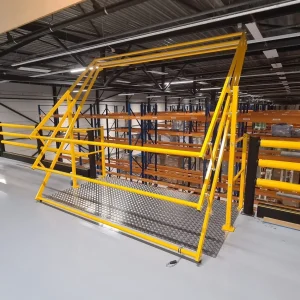
The strength of the TÜV certification of Variogate pallet gates lies in the combination of these standards.
Together, they ensure that:
This results in a complete package in which not only the final product is assessed, but also the way it is manufactured, assembled, and inspected.
A pallet gate is used as collective fall protection in places where employees work at height. In such situations, there must be no doubt about the quality and reliability of the system.
By choosing a pallet gate whose TÜV certification is based on multiple recognized safety standards, you can be assured that key parts of the production and quality process have been independently assessed.
This provides confidence not only for users, but also for safety officers, project managers, contractors, and prevention advisors who are responsible for maintaining a safe working environment.
At Haagh Protection, safety is central. That is why the decision was made not to limit the Variogate pallet gates to a single TÜV certificate, but to base the certification on multiple internationally recognized standards.
This ensures that not only the final product is assessed, but the entire chain is evaluated: from production and welding to structural calculations and the final application of the pallet gate.
This makes the TÜV certification of Variogate more than just a quality mark. It is verifiable proof that quality and safety are secured on multiple levels.
The term “pallet gate TÜV certification” is frequently used, but without further explanation it says little about the actual quality of a product.
The content of the TÜV certificate is ultimately much more important than the name of the certification body. It is precisely the underlying safety standards that show which requirements have been set for production, construction, welding, and structural safety.
For Haagh Protection’s Variogate pallet gates, this foundation consists of EN 1090-1, EN 14122-3, EN ISO 9606, and NEN 6702. Together, these standards form a solid basis for a reliable and safe pallet gate suitable for use as collective fall protection in industrial environments.
A TÜV certificate is an independent proof that a product, process, or structure has been assessed by a recognized certification body. However, the certificate itself is not a standard. The value of a TÜV certificate is determined by the standards on which the certification is based.
A pallet gate TÜV certification means that the pallet gate has been assessed against specific safety and quality standards. For Haagh Protection’s Variogate pallet gates, this certification includes, among others, EN 1090-1, EN 14122-3, EN ISO 9606, and NEN 6702. These standards relate to the production, construction, welding, and structural safety of the system.
Safety standards ensure that a pallet gate is not only safe in appearance, but also demonstrably complies with established requirements in terms of design, production, and structural strength. This ensures that the system has been independently assessed according to recognized national and European standards.
A CE marking is a declaration by the manufacturer that a product complies with applicable European laws and regulations. A TÜV certificate, on the other hand, is issued by an independent certification body that assesses whether a product or production process meets specific standards. CE and TÜV complement each other, but serve different functions.
EN 1090-1 sets requirements for the production of load-bearing steel structures. This standard ensures that production takes place under a controlled quality management system and that manufacturing demonstrably meets the specified requirements. For a pallet gate, this means consistent and controlled production quality.
EN 14122-3 describes the safety requirements for permanent means of access and safety barriers in industrial environments. The standard sets requirements for, among other things, the dimensions, strength, and construction of guardrails, ensuring they can be safely used as collective fall protection.
The quality of welds has a major influence on the strength of a steel structure. EN ISO 9606 ensures that welders possess the appropriate professional competence and carry out their work in accordance with internationally recognized quality standards.
A TÜV-certified pallet gate provides assurance regarding the quality of both the production process and the construction. Thanks to the combination of recognized safety standards, you are guaranteed a pallet gate that is designed, manufactured, and inspected according to high quality and safety requirements. This contributes to a safe working environment and reliable collective fall protection.