
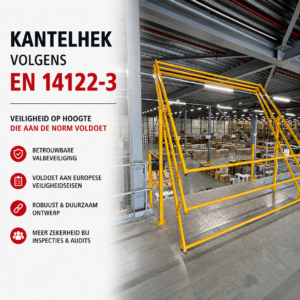
A safety pallet gate is an essential component of a safe working environment at height. Whether installed on a loading platform, mezzanine floor, smal landing, or industrial installation, a tilting gate prevents employees from being exposed to the risk of falling. But how do you know if a pallet gate actually meets the correct safety requirements?
An important guideline in this regard is the EN 14122-3 standard. In this blog, we explain what this standard entails, why a safety pallet gate must comply with it, and what to look out for when choosing a suitable system.
EN 14122-3 is a European standard that sets requirements for permanent access means to machines and industrial installations. Part 3 of this standard focuses specifically on stairs, landings, walkways, and handrails used to provide safe access to workplaces.
The standard describes, among other things:
• Minimum heights of handrails;
• Dimensions of intermediate beams and plinths;
• Structural strength and stability;
• Requirements for openings to limit the risk of falling;
• Safe shielding of workplaces at height.
Although the standard was originally developed for access systems around machines, in practice it is also widely applied as a guideline for safety devices such as tilt gates.
A safety pallet gate often forms the final physical barrier between an employee and a potentially dangerous fall. When a tilt gate complies with EN 14122-3, you know that it has been designed according to proven European safety requirements.
This offers several benefits:
• A lower risk of fall incidents;
• Safe shielding of openings and loading areas;
• A robust construction capable of withstanding the prescribed loads;
• Support in complying with the Working Conditions Act and the Machinery Directive, or the applicable European regulations;
• Greater certainty during safety inspections and audits.
By choosing a pallet gate that meets the standard, you invest not only in employee safety but also in the continuity of your business processes.
Optimal fall protection
A well-designed pallet gate always keeps one side of the opening closed. This creates a safe workplace, even when goods are being loaded or unloaded.
Meeting European safety requirements
When a safety gate is designed in accordance with EN 14122-3, it complies with the applicable European directives for permanent safety devices.
Reliable quality
A safety gate manufactured according to this standard meets requirements regarding strength, dimensions, and durability. This results in a longer lifespan and less maintenance.
More confidence during inspections
Employers are responsible for a safe workplace. Using a safety pallet gate that complies with EN 14122-3 helps demonstrate that appropriate safety measures have been taken.
Not every pallet gate offers the same level of security. Therefore, pay attention to the following points.
Does the gate comply with EN 14122-3?
Always ask for the technical specifications or documentation showing that the design complies with the standard.
Is the construction suitable for the application?
A pallet gate for a warehouse places different demands than fencing for a platform or an industrial installation. Therefore, choose a solution that matches the load and intensity of use.
Is the gate easy to operate?
A good pallet gate operates smoothly and automatically locks the open side. This ensures security remains guaranteed even during daily use.
Has the quality been independently demonstrated?
In addition to conformity with EN 14122-3, independent certification can offer extra assurance. When a product has been tested and assessed by an external party, you know that the stated performance has actually been verified.
The EN 14122-3 standard describes the requirements a safe pallet gate must meet. A TÜV certification subsequently demonstrates that an independent body has assessed whether a product actually meets the specified requirements.
The standard therefore forms the technical starting point, while certification provides additional confidence in the quality and safety of the product.
Read more about this in our blog about TÜV certification, where we explain what a TÜV mark entails, how certification takes place, and why this can be a significant added value when choosing safety solutions.
A safety pallet gate that complies with EN 14122-3 offers a reliable solution for preventing the risk of falling at height. The standard sets clear requirements for the construction, dimensions, and safety of permanent access systems. By choosing a tilt gate that meets this standard, you reduce the risk of accidents, better comply with relevant laws and regulations, and invest in a sustainable safety solution.
Therefore, always check whether a pallet gate is demonstrably designed in accordance with EN 14122-3 and preferably choose a solution that has also been independently tested or certified. This ensures maximum safety for both employees and the organization.

